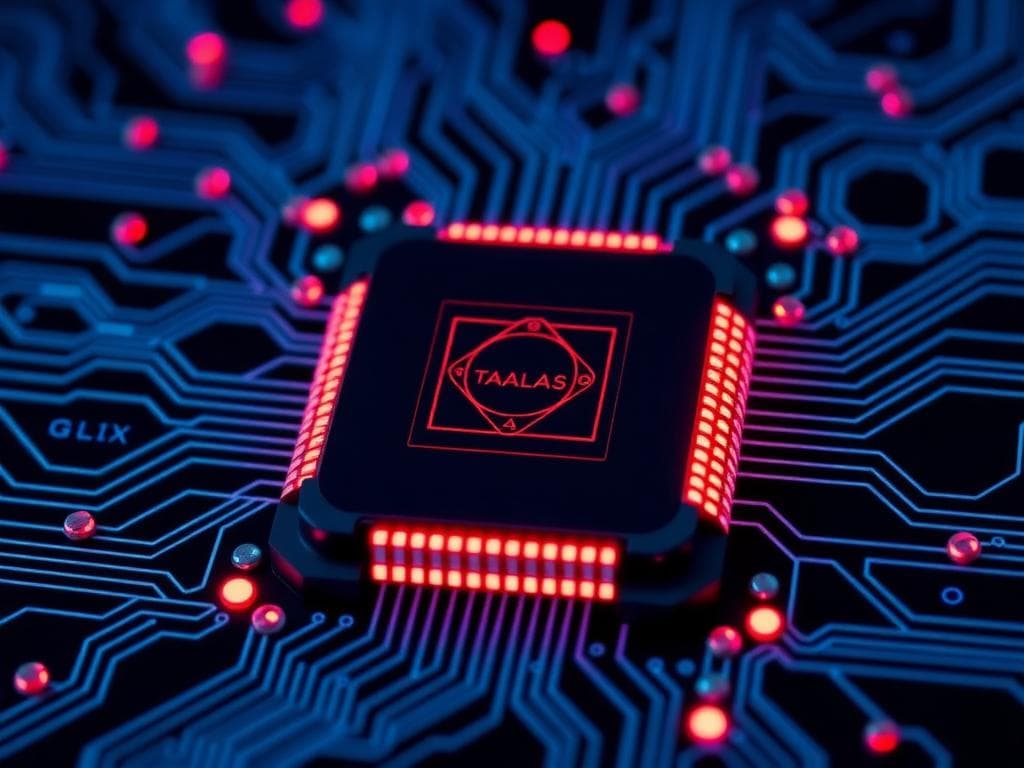
Taalas Unveils Hard-Wired AI Chip Delivering 17K Tokens/sec
Breaking the GPU Bottleneck: A New Path to Ubiquitous AI
The promise of AI as a transformative, general-purpose technology is undeniable. Yet, its widespread adoption has been bottlenecked by two persistent constraints: high latency and astronomical cost. Interactions with large language models (LLMs) often lag far behind human thought, disrupting workflows. Meanwhile, deploying modern models demands room-sized supercomputers consuming hundreds of kilowatts.
Startup Taalas, founded 2.5 years ago, is challenging this paradigm with a radical architectural approach. The company has developed a platform to transform any AI model directly into custom silicon, a process it claims takes only two months from receiving a previously unseen model. Its first product, unveiled today, is a hard-wired implementation of Meta's Llama 3.1 8B model.
This specialized chip, the Taalas HC1, delivers what the company calls "Hardcore Models." Performance data claims it achieves 17,000 tokens per second per user. Taalas states this is nearly 10 times faster than the current state of the art, while costing 20 times less to build and consuming 10 times less power.
Architectural Philosophy: Total Specialization and Merged Memory
Taalas's breakthrough stems from three core principles that upend conventional AI hardware design. The first is total specialization. Rather than building general-purpose processors like GPUs, Taalas creates optimal silicon tailored for each individual model, arguing AI inference is the most critical workload to benefit from such deep specialization.
The second principle addresses a fundamental hardware paradox: merging storage and computation. Modern inference is hamstrung by the separation between fast compute chips and dense, cheaper DRAM memory, connected by bandwidth-limited interfaces. This divide necessitates complex, expensive solutions like HBM stacks and liquid cooling.
Taalas eliminates this boundary by unifying storage and compute on a single chip at DRAM-level density. This architectural shift enables the third principle: radical simplification. By removing the memory-compute bottleneck, the company redesigned its hardware stack from first principles, eliminating the need for HBM, advanced packaging, 3D stacking, or liquid cooling.
Product Launch and Performance Context
The company selected Llama 3.1 8B for its first product due to its small, practical size and open-source availability. The resulting HC1 board is largely hard-wired for speed but retains configurable context windows and supports fine-tuning via Low-Rank Adapters (LoRAs). The first-generation silicon uses a custom 3-bit base data type, leading to some quality degradation relative to GPU benchmarks due to aggressive quantization.
Taalas is already addressing this with its second-generation silicon (HC2), which adopts standard 4-bit floating-point formats. The company's product roadmap includes a mid-sized reasoning LLM on HC1 silicon expected this spring, followed by a frontier LLM fabricated on the HC2 platform planned for winter deployment.
The Broader AI Hardware Landscape
Taalas enters a fiercely competitive market dominated by Nvidia, which continues to push performance boundaries. Recent reports highlight Nvidia's Blackwell Ultra architecture, which promises up to 50 times higher tokens per watt and strong long-context performance for "agentic AI" applications. Nvidia has also managed to reduce token costs by a reported 10 times with its newest platform.
However, the cost of AI infrastructure extends beyond processing. As noted by TechCrunch, memory (DRAM) is an increasingly critical and expensive component, with prices jumping roughly 7 times in the last year. Efficient memory orchestration is becoming a key differentiator, as using fewer tokens per query directly impacts profitability.
A Shift in Adoption Trajectory?
The quest for ubiquitous AI mirrors historical technological revolutions. The path from ENIAC—a room-sized, power-hungry behemoth—to today's smartphones required computing to become easy to build, fast, and cheap. Taalas argues AI must follow the same trajectory to enter the mainstream.
Adoption is already scaling rapidly. Google CEO Sundar Pichai recently reported that first-party models like Gemini now process over 10 billion tokens per minute via direct API use. The Gemini App has grown to over 750 million monthly active users, indicating massive consumer and enterprise uptake.
As models become more efficient and inference costs drop, previously unviable applications will edge into profitability. The industry is moving beyond mere experimentation into a phase of sustained productivity gains, reminiscent of the long transformation from steam to electricity.
Why This Matters: Enabling New Application Classes
Taalas is releasing its first model as a beta service, acknowledging it is not on the "leading edge" of model capability. The goal is to let developers explore what becomes possible when LLM inference runs at sub-millisecond latency and near-zero cost. The company believes this enables entire classes of applications previously deemed impractical.
Automated, agentic AI applications demand millisecond responses, not the leisurely, human-paced interactions common today. By removing traditional latency and cost constraints, Taalas aims to foster a new wave of innovation. The company, a team of just 24 that spent $30 million of its $200 million+ funding to reach this point, positions itself as a "precision strike" in a landscape of well-funded, hype-driven competitors.
Disruptive advances rarely look familiar at first. Taalas's technology, born from questioning fundamental architectural assumptions, represents a fundamentally different paradigm for building and deploying AI systems. Its success will depend on the industry's willingness to understand and adopt this new operating model, and on developers leveraging its unprecedented speed and efficiency to build the next generation of intelligent applications.
Related News

Cerebras Details Trillion-Parameter AI Model Deployment on Wafer-Scale Chips

AI's Economic Payoff Still Confined to Tech Sector, Data Shows

AI Image Generation in 2026: A Practical Guide to Models, Costs, and Agents

Block's Dessa: AI Voice Model Trained Only on Speech

NVIDIA OpenShell: A Secure Runtime for Autonomous AI Agent Fleets
