Navy EA-18G Growlers Collide at Idaho Airshow, Crews Eject Safely
Mid-Air Collision Grounds Airshow, Highlights Ejection System Success
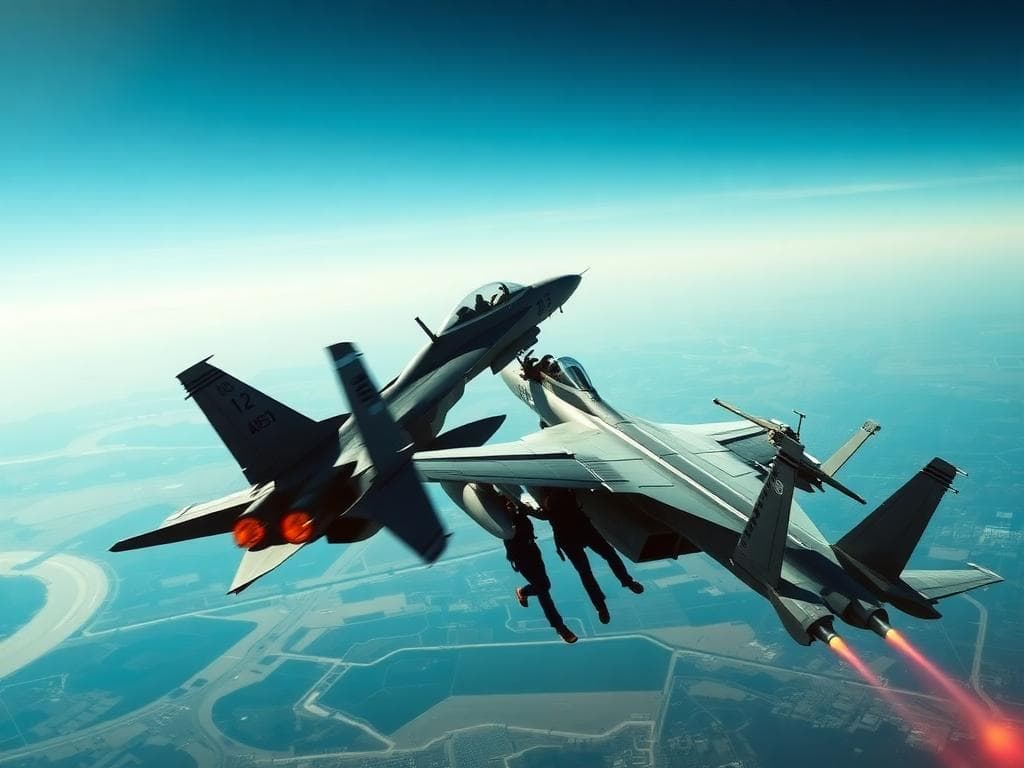
A dramatic mid-air collision between two sophisticated U.S. Navy fighter jets marred the Gunfighter Skies airshow at Mountain Home Air Force Base in Idaho on Sunday, May 17, 2026. Spectator footage captured the moment two EA-18G Growler electronic warfare aircraft collided and crashed, though the event concluded with a fortunate outcome: all four crew members ejected safely and were reported in stable condition.
The incident occurred roughly two miles from the base during an aerial demonstration. According to Naval Air Forces, the jets were from Electronic Attack Squadron 129 based at Whidbey Island, Washington. The remainder of the airshow was immediately canceled, and the base enacted a lockdown as emergency crews responded to the scene.
Video from spectator Shane Ogden shows the two jets appearing to make contact, becoming briefly entwined before plummeting to the ground in a fiery explosion. Crucially, the footage shows four parachutes deploying simultaneously as the aircraft spun, a testament to the timing and functionality of the onboard ejection systems.
Technical Analysis: The EA-18G Growler and the Margin for Error
The loss of these two aircraft carries significant weight beyond the immediate safety scare. The EA-18G Growler is a specialized variant of the F/A-18F Super Hornet, designed for electronic attack and suppression of enemy air defenses. Its advanced systems are increasingly vital in modern combat scenarios.
Notably, production of the Growler ceased in the late 2010s, making each existing airframe a high-value, finite asset for the Navy. The simultaneous loss of two represents a tangible reduction in this specialized fleet capability.
Former pilot and Top Gun instructor Dave Berke provided context on the perilous situation to CBS News. He noted the jets were flying at "very low altitude and also relatively slow speeds" during the collision, leaving an incredibly narrow margin for a successful ejection. Berke suggested a significant degree of luck was involved in all four crew members surviving.
Investigation Launched, Airshow Safety Under Scrutiny
The U.S. Navy has launched a formal investigation into the cause of the collision. Initial reports from officials and event organizers confirmed no one on the ground was injured. Kim Sykes, marketing director for event co-organizer Silver Wings of Idaho, emphasized that the safety of the crew was the paramount concern.
This incident inevitably renews focus on airshow safety protocols. The industry, which hosts roughly 200 events annually in the U.S., has worked to improve safety standards for years. The last fatal crash at a U.S. airshow occurred in 2022 in Dallas, involving vintage military aircraft.
While the Thunderbirds, the U.S. Air Force's demonstration squadron, were scheduled to headline the Mountain Home event, they were not involved in this incident. The crash serves as a stark reminder of the inherent risks in high-performance aerial demonstrations, even with rigorous training and modern equipment.
Why This Incident Matters Beyond the Headlines
This event is more than a local news story. It intersects several critical themes in defense aviation. First, it underscores the continued reliability and life-saving potential of modern ejection seat technology, which performed flawlessly under extreme duress.
Second, it highlights the operational risk associated with demonstrating front-line combat aircraft, assets that are both expensive and difficult to replace. Finally, it will likely prompt a review of demonstration procedures for multi-ship electronic warfare aircraft, a complex and demanding discipline.
The successful ejection of all personnel is the definitive positive outcome. However, the investigation's findings will be closely watched by naval aviation, the airshow industry, and defense analysts concerned with force preservation and safety culture.
Related News

AI's Economic Payoff Still Confined to Tech Sector, Data Shows

AI Image Generation in 2026: A Practical Guide to Models, Costs, and Agents

Block's Dessa: AI Voice Model Trained Only on Speech

NVIDIA OpenShell: A Secure Runtime for Autonomous AI Agent Fleets

WorldTUI: A 360M Model That Simulates a Terminal Without a Shell