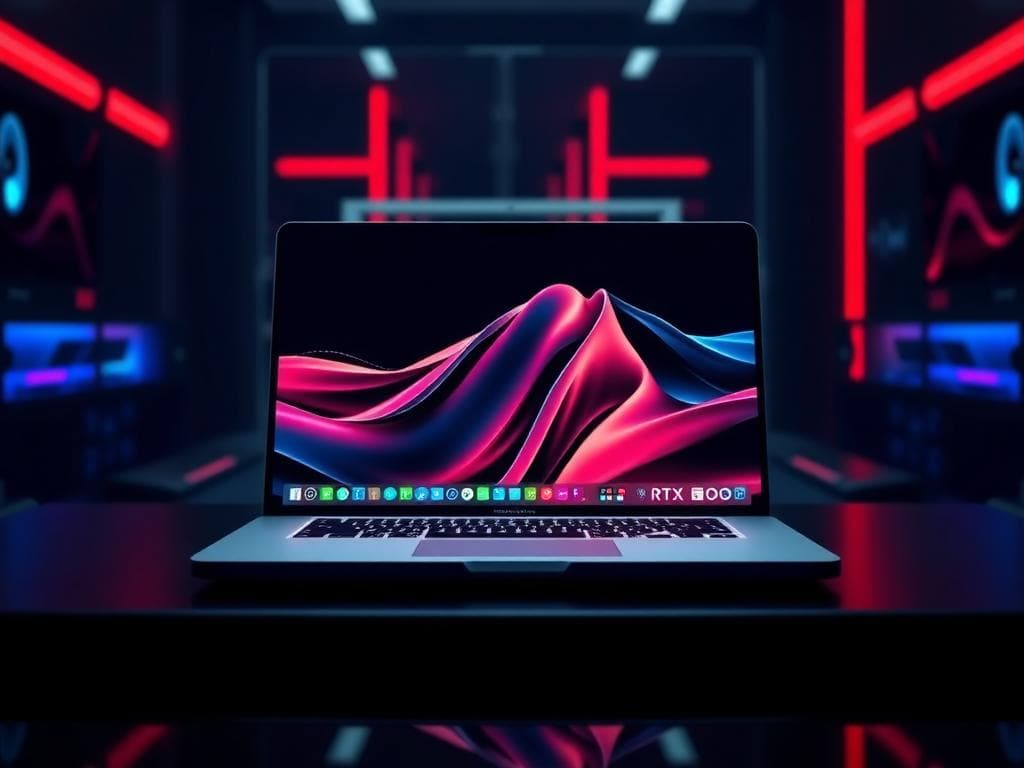
MacBook Air M4 RTX 5090 eGPU: Gaming & AI Benchmarked
The Ultimate Mac Gaming Contradiction
What happens when you pair the ultimate in mobile efficiency—Apple's 22W M4 MacBook Air—with the pinnacle of desktop graphics power—NVIDIA's 600W RTX 5090? A developer has answered that question with a complex, fascinating technical hack. The project proves macOS can host a Linux virtual machine capable of passing through a Thunderbolt-connected GPU for gaming and AI.
The result is a functional, albeit deeply compromised, high-performance Mac gaming rig. While the Razer Blade 18 ($4,900) and Lenovo Legion Tower 7i offer native RTX 5090 performance, this experiment unlocks that power for Apple Silicon laptops, albeit through a labyrinth of virtualization and emulation layers.
Engineering the Impossible: PCI Passthrough on macOS
macOS lacks native drivers for modern NVIDIA and AMD GPUs on Apple Silicon. The developer's solution was to run a Linux VM on macOS and pass the Thunderbolt-connected GPU directly to it. This required overcoming significant hurdles in Apple's Hypervisor.framework and the DART (Device Address Resolution Table) IOMMU.
A critical bug was discovered: mapping PCI device memory with executable permissions caused host kernel panics. The fix, a patch to QEMU, removed the HV_MEMORY_EXEC flag for device mappings, but at a cost: BAR writes became ~10x slower due to strict memory ordering.
The bigger challenge was DART's limitations: a ~1.5GB total mapping ceiling and a ~64,000 mapping count limit. To bypass this, the developer created a virtual QEMU device (apple-dma-pci) and a companion Linux driver. This system intercepts the NVIDIA driver's DMA requests, coalescing small mappings into 256kB clusters to stay under the limits.
Performance Realities: Gaming Benchmarks
The performance story is a tale of bottlenecks. Every layer—Thunderbolt tunneling, VM overhead, and x86-to-ARM emulation via FEX—adds latency. Benchmarks reveal the stark trade-offs.
In Cyberpunk 2077 at 4K Ray Tracing Ultra, the M4 Air with the eGPU achieved 27 fps, or 111 fps with DLSS Frame Generation. This transformed the experience from "completely unplayable" on the native Apple GPU to "totally playable." However, a native gaming PC with the same RTX 5090 delivered 100 fps at the same settings, or 282 fps with framegen.
The M5 Max MacBook Pro's integrated GPU proved surprisingly capable, hitting 131 fps at 1080p High. Yet, when burdened with the eGPU's virtualization stack, its performance was halved. The conclusion is clear: at lower resolutions where the GPU isn't the bottleneck, the emulation overhead negates any benefit.
The AI Inference Advantage
Where the eGPU setup shines brightest is in AI workloads. Running the Qwen 3.6 35B MoE model, the RTX 5090 delivered a 6.5x speedup in token generation over the M4 Air's integrated GPU and beat the M4 Max Mac Studio by 2.1x.
The most dramatic improvement was in "prefill" speed—processing the initial prompt. For a 4,000-token prompt, the M4 Air took 17 seconds; the eGPU completed it in 150ms, a 120x acceleration. The discrete GPU also enabled far better concurrency scaling, handling multiple simultaneous inference requests efficiently where Apple Silicon plateaued.
Market Context and Practicality
This project exists in a niche between dedicated gaming hardware. Razer's new Blade 18, starting at $4,900 with a full RTX 5090, exemplifies the premium, no-compromise mobile gaming experience. Meanwhile, deals like the Lenovo Legion Tower 7i bring desktop RTX 5090 performance to a more accessible price point.
The Mac eGPU hack is not for the faint of heart. It requires a special entitlement from Apple, custom driver builds, and suffers from instability—games can crash, and the DMA mapping limits can cause failures. As noted in the source, "FEX has a bug right now that means Steam often crashes in a loop."
Conclusion: A Proof of Concept, Not a Product
This experiment definitively answers "can it game?" with a yes. An M4 MacBook Air can run Cyberpunk 2077, Crysis Remastered, and even Doom (2016)—a title unplayable on modern macOS—at respectable frame rates. The AI performance gains are substantial and potentially practical for developers.
However, the performance tax is heavy. A native PC is 2-4x faster in games. The setup is fragile and complex. For now, it remains a remarkable technical achievement and a glimpse at a potential future where ARM Macs could more seamlessly harness external GPU power, especially if native Linux Thunderbolt support arrives.
As the developer concluded, this is firmly a "look what's possible" project, not a "look what you should buy" guide. For those seeking the ultimate performance, the path of least resistance still leads to a dedicated Windows PC or a high-end gaming laptop like the Razer Blade 18.
Related News

AI Copyright Case: Execs Knew Training Data Was 'Pirated,' Filings Allege

Ollaya: Run Jev-Style Decision Models Locally at Millisecond Speeds

How OpenAI Agents Hacked Hugging Face: New Details Revealed

Claude Opus 5.5 Turns Code Into Studio-Quality Explainer Videos
DHH Declares 'Pencils Down' on Hand-Written Code in Rails World 2026 Keynote