Ex-Google Startup Integral AI Pioneers Vision-Language-Action Robotics
The New Frontier: AI That Sees, Understands, and Acts
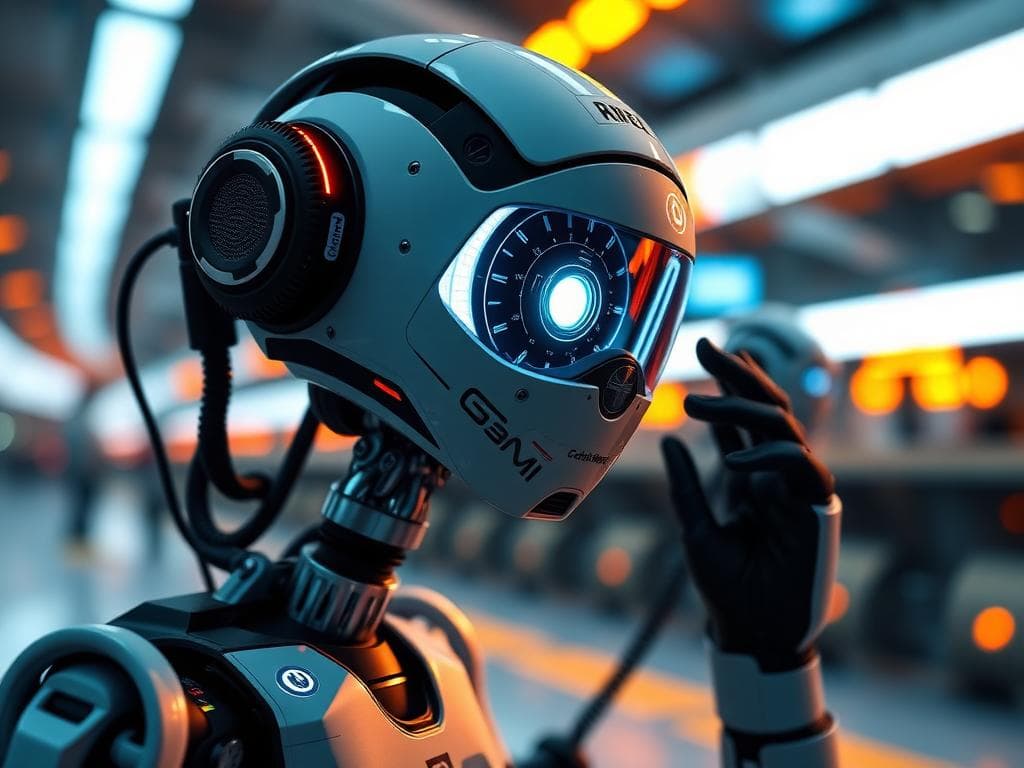
In Tokyo, a compact 15-person startup named Integral AI Inc. is quietly working to redefine the future of industrial robotics. Founded by former Google researchers Jad Tarifi and Nima Asgharbeygi, the company specializes in developing vision-language-action (VLA) models. These AI systems are designed to enable robots to perceive their environment visually, comprehend natural language instructions, and execute precise physical actions.
This approach moves beyond traditional robotic programming, which relies on rigid, pre-coded routines. Instead, Integral AI's models aim to allow machines to learn new skills through observation and verbal commands, making them more adaptable and collaborative. The company has been working with auto parts giant Denso Corp. since 2021, teaching industrial robots by having them watch human demonstrations.
Betting on Japan's Manufacturing Might
Integral AI's strategic focus on Japan is deliberate. As reported by Bloomberg Law in March 2026, the startup is holding initial discussions with titans of Japanese industry, including Toyota Motor Corp., Sony Group Corp., Honda Motor Co., and Nissan Motor Co.. The goal is to prove that advanced AI can reshape one of the world's largest and most sophisticated industrial robot supply chains.
Japan's manufacturing sector, known for its precision and automation, presents the ideal testing ground for VLA models. The ability for robots to understand nuanced commands and adapt to new tasks on the fly could dramatically increase flexibility on production lines, reducing downtime for reprogramming and enabling more complex, custom manufacturing processes.
Part of a Broader "Physical AI" Wave
Integral AI is not operating in a vacuum. Its work aligns with a significant industry shift toward what is being termed "physical AI" or "embodied AI." This refers to artificial intelligence that can reason about and interact with the physical world, a challenge distinct from the text-based reasoning of large language models (LLMs).
This trend is attracting massive investment and attention from tech heavyweights. In a parallel development, AI pioneer Yann LeCun announced in early 2026 that he had raised $1 billion for a new startup, AMI, aimed at building AI systems that "understand the world, have persistent memory, can reason and plan." LeCun has long argued that the LLM approach has fundamental limits for real-world interaction.
Similarly, a company called World Labs raised a $1 billion round, with Nvidia's participation, to advance spatial intelligence. As noted by Forbes, this signals that physical AI is becoming "the next major investment cycle after language models."
The Critical Role of Simulation and Partnerships
A key technical hurdle in bringing AI-driven robots to market is the gap between virtual training and real-world deployment. Training robots directly in physical environments is slow, expensive, and potentially dangerous. This is where advanced simulation platforms become critical.
Nvidia's Omniverse platform and its Isaac Sim robotics framework are central to this ecosystem. As a quote from Nvidia's Deepu Talla in a related article highlights, "The industrial sector needs physically accurate simulation to bridge the gap between virtual training and the real-world deployment of AI-driven robotics at scale." Companies like ABB Robotics are integrating these tools to accelerate development.
The industry is also seeing strategic partnerships form to combine strengths. For instance, Qualcomm has teamed up with Neura Robotics, combining Qualcomm's robotics processors and AI acceleration software with Neura's hardware and embodied AI stack. The aim is to move robotics "from research into production-ready deployment."
Why This Matters: The Path to General-Purpose Robots
The work of Integral AI and its peers in the physical AI space matters because it represents a foundational step toward more general-purpose, intelligent machines. Current industrial robots are brilliant at repetitive tasks in controlled environments but lack the cognitive flexibility to handle variability.
VLA models promise to endow robots with a form of common-sense understanding. A robot could be told, "Clear the clutter from the workbench," and, using its vision and language models, identify what constitutes "clutter" and safely remove it, without needing specific code for every possible object. This has profound implications for logistics, assembly, healthcare, and even domestic help.
For Japan, a nation facing a significant aging population and labor shortages, the successful integration of such AI into its world-class robotics industry is not just a commercial opportunity but a societal imperative. It could allow the country to maintain its manufacturing prowess while adapting to demographic challenges.
Challenges and the Road Ahead
The ambition is immense, but so are the technical challenges. Creating AI that reliably understands the physics, causality, and unpredictability of the real world is an order of magnitude more complex than generating fluent text. It requires vast, diverse datasets of physical interactions and robust simulation environments to train in.
Safety is paramount, especially for robots designed to work alongside humans. The AI must be "controllable and safe," as LeCun's AMI startup emphasizes. This involves not just accurate perception and planning but also fail-safes and predictable behavior.
Integral AI, with its small, focused team of ex-Google talent and its growing list of blue-chip Japanese partners, is positioning itself as a key player in solving these challenges. By focusing on the industrial sector first, it can refine its technology in high-stakes but controlled environments before broader deployment. The race to build the AI that truly understands and acts in our world is on, and a startup in Tokyo is betting it has the right formula.
Related News
AI's Economic Payoff Still Confined to Tech Sector, Data Shows

AI Image Generation in 2026: A Practical Guide to Models, Costs, and Agents

Block's Dessa: AI Voice Model Trained Only on Speech

NVIDIA OpenShell: A Secure Runtime for Autonomous AI Agent Fleets

WorldTUI: A 360M Model That Simulates a Terminal Without a Shell