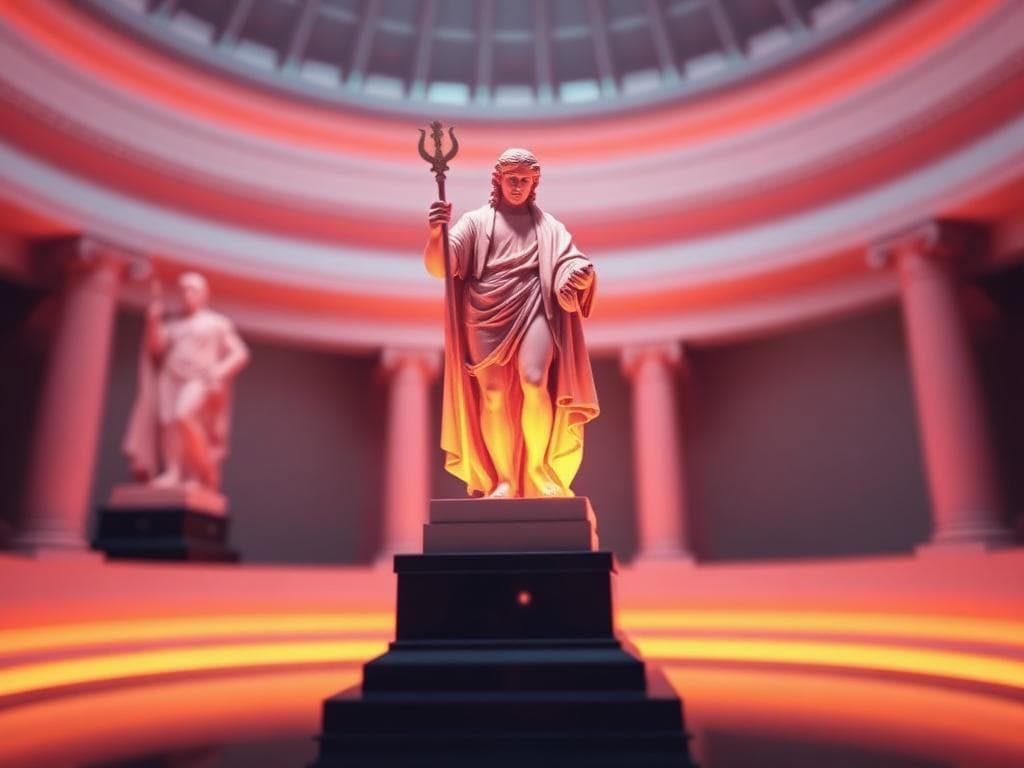
Reevaluating Classical Statue Coloration: A Nuanced Perspective
Challenging Conventional Wisdom on Classical Statues
For centuries, the prevailing narrative surrounding classical statues has been that they were once vibrantly, even garishly, painted. However, a recent in-depth analysis is forcing a reevaluation of this notion, suggesting that the actual coloration may have been more subtle and nuanced.
The traditional view posits that ancient Greeks and Romans adorned their statues with bright, bold colors, a practice often seen as at odds with modern aesthetic sensibilities. This perception has been fueled by various historical accounts and the occasional discovery of pigment residues on statues.
A More Nuanced Understanding of Coloration
Recent research, however, indicates that the coloration of classical statues may have been more restrained than previously thought. By examining the residues of pigments on statues and analyzing ancient texts, researchers have begun to piece together a more accurate picture of ancient coloration practices.
- Analysis of pigment residues reveals a more limited palette than previously assumed.
- Ancient texts suggest a sophisticated understanding of color theory and its application.
- The role of patina and aging in the appearance of classical statues is being reevaluated.
Implications for Art History and Beyond
This revised understanding of classical statue coloration has far-reaching implications, not only for art historians but also for the broader cultural landscape. It challenges our assumptions about ancient aesthetics and invites a reconsideration of the cultural context in which these works were created.
Moreover, this research underscores the importance of interdisciplinary approaches to understanding historical artifacts. By combining insights from art history, archaeology, and materials science, researchers can gain a more comprehensive understanding of the past.
Technical Insights and Methodologies
The study employed a range of cutting-edge techniques, including:
- Multispectral imaging: to analyze the chemical composition of pigment residues.
- Scanning electron microscopy (SEM): to examine the surface morphology of statues.
- X-ray fluorescence (XRF): to determine the elemental composition of pigments.
These methodologies allowed researchers to reconstruct the original coloration of classical statues with greater accuracy, shedding new light on the artistic practices of ancient civilizations.
Related News

Cerebras Details Trillion-Parameter AI Model Deployment on Wafer-Scale Chips

AI's Economic Payoff Still Confined to Tech Sector, Data Shows

AI Image Generation in 2026: A Practical Guide to Models, Costs, and Agents

Block's Dessa: AI Voice Model Trained Only on Speech

NVIDIA OpenShell: A Secure Runtime for Autonomous AI Agent Fleets
