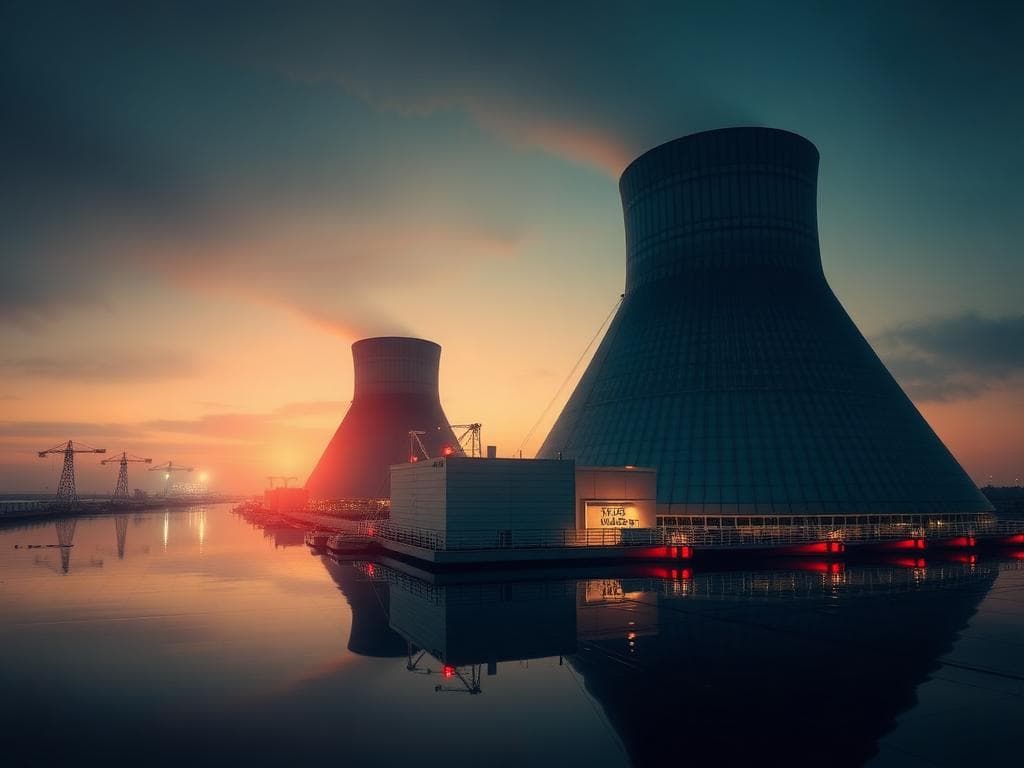
Canada's Nuclear Renaissance: $100B Plan Targets 10 Reactors by 2040
Canada Bets Big on a Nuclear Future
In a significant move to reshape its energy landscape, the Canadian federal government has launched an ambitious national nuclear strategy. Energy Minister Tim Hodgson announced plans for a "new civilian nuclear renaissance," targeting the construction of up to 10 new nuclear reactors by 2040. The comprehensive plan, revealed on Monday, June 17, 2026, is a cornerstone of Canada's goal to double its electrical grid capacity by 2050 while pursuing a low-carbon economy.
"If our goal is to double our grid and build a low-carbon economy in less than 25 years, there is no credible plan to do that without nuclear energy and the clean, reliable baseload power it provides," Hodgson stated at a news conference in Newmarket, Ontario. Officials from Natural Resources Canada, in a technical briefing, estimated the construction costs for this reactor fleet could exceed $100 billion, though the strategy does not specify a funding mechanism.
The Roadmap: Reactors, Exports, and Jobs
The strategy outlines a concrete, phased approach. By 2035, the government aims to start construction on two new large-scale reactors. It further calls for five more to be in planning or under development by 2040, and mandates that at least one reactor be under construction outside of Ontario by 2035. For remote communities, the plan targets the finalization of a Canadian-made microreactor design by 2035, with deployment slated for the late 2030s.
Beyond domestic power, the strategy has a strong export and economic focus. It aims to at least double the number of jobs in the nuclear industry. Crucially, it seeks to expand sales of Canada's proprietary CANDU reactor technology into new international markets. The goal is to break into at least four new markets by 2040 and engage six to ten "nuclear entrant" countries over a 15-year horizon.
"Reactor exports are not transactional. They establish multi-decade partnerships, creating durable geopolitical and commercial relationships that advance Canada's broader foreign policy interests," the strategy document asserts. It positions CANDU exports as a central instrument for diversifying trade and strengthening ties with middle powers.
Geopolitics and Fuel Security
The export push is intertwined with global energy security. With thirty CANDU reactors operating worldwide and two more planned, Canada sees an opportunity as Western allies seek to reduce dependence on Russian nuclear fuel services. Unlike most reactor designs, CANDU reactors use natural, unenriched uranium, a resource Canada holds in abundance.
The strategy notes that if CANDU exports stall, Canada should consider developing domestic uranium enrichment capabilities to fuel other types of reactors. "The longer-term question of whether Canada should develop domestic enrichment capability remains under assessment," the document says, adding that partnerships with trusted allies would ensure fuel security.
This aligns with broader global trends. The World Nuclear Association projects uranium demand for reactors to climb 28% by 2030, reaching nearly 87,000 tonnes annually, and more than double to over 150,000 tonnes by 2040. Furthermore, advanced reactor designs like Oklo's Aurora require High-Assay Low-Enriched Uranium (HALEU), a fuel currently not available at commercial scale outside Russia.
Market Movements and Mining Realities
The announcement comes amid notable activity in the nuclear sector. On June 18, 2026, Sam Altman-backed fission company Oklo announced a deal with Centrus Energy to supply HALEU fuel for up to five of its Aurora microreactors, with deliveries starting in 2029. While such deals signal growing momentum for advanced reactors, a reality check exists for the mining industry, a presumed key customer for Small Modular Reactors (SMRs).
Analyses suggest that while SMRs are theoretically ideal for remote, off-grid mining operations seeking to replace diesel, they are "still not on miners’ shopping lists." Ontario's energy plan, which includes a C$20.9 billion commitment to SMRs and could add 10,000 MW of nuclear capacity, is seen as a potential boon for uranium mining and for supplying mining regions via the expanded grid, rather than through individual mine-site reactors.
Ethics and Implementation
The strategy's release involved notable ethical precautions. The document confirms that Prime Minister Mark Carney was not shown the plan and played no role in its development due to an ethics screen. This is because Carney's blind trust holds assets in Brookfield Corporation and Brookfield Asset Management, which co-own a reactor model that competes with CANDU technology.
The massive scale of the plan raises immediate questions about execution. The $100 billion+ price tag requires significant public and private investment. Success will depend on navigating complex regulatory processes, securing supply chains for specialized components, and training a skilled workforce. The strategy represents a high-stakes bet on nuclear technology as the backbone of Canada's future energy security and its ambition to become a global "energy superpower."
Related News

Spain Blocks Archive.today and Mirrors Without Court Order

Open-Source Laya Challenges Jev in Fast AI Decisions

AI Posters Don't Have to Be Ugly: A Design Guide

Brain Is Two Separate Organs: Stanford Study Overturns Decades of Neuroscience

LLM Writing Guide: Rules, Tools, and AI's Expanding Role