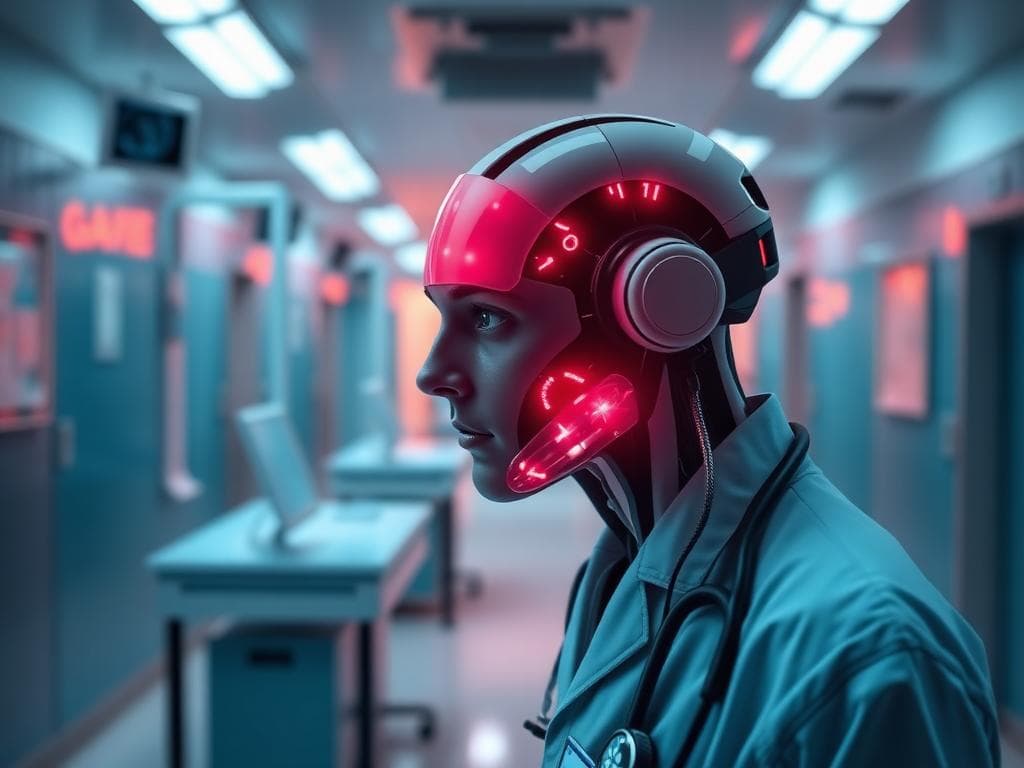
AI Outperforms Doctors in ER Triage Diagnosis, Harvard Study Finds
A New Benchmark in Clinical AI
A landmark study from Harvard Medical School and Beth Israel Deaconess Medical Center has demonstrated that advanced artificial intelligence can outperform experienced physicians in the high-stakes environment of emergency room triage. Published in the journal Science, the research tested OpenAI's reasoning model, o1-preview, against two attending physicians from elite institutions, using real patient cases.
The AI system achieved a correct or very close diagnosis in 67.1% of 76 actual emergency department cases. In contrast, the human doctors scored 55.3% and 50.0% accuracy, respectively. This performance gap was most significant during the initial triage phase, where decisions must be made rapidly with minimal patient information.
"We tested the AI model against virtually every benchmark, and it eclipsed both prior models and our physician baselines," said Arjun Manrai, a lead author and head of an AI lab at Harvard Medical School. The findings suggest a profound shift in the capabilities of large language models (LLMs) for clinical reasoning.
Methodology and Key Findings
The study was designed to mimic real-world clinical scenarios. Both the AI and the physicians were given identical, unprocessed electronic health records from the Boston hospital's ER. These records typically included vital signs, demographic data, and a few sentences from a nurse about the patient's presenting complaint.
Blinded physician reviewers could not reliably distinguish between diagnoses generated by the AI and those from their human counterparts. This indicates the AI's output was clinically coherent and indistinguishable from expert human reasoning in format and style.
When more detailed information became available later in a patient's stay, diagnostic accuracy improved for all parties. The AI's accuracy rose to 81.6%, compared to 78.9% and 69.7% for the physicians, though this later difference was not statistically significant.
Superior Performance on Complex Cases
The researchers extended their evaluation to a separate set of 143 complex clinical vignettes published in The New England Journal of Medicine. Here, OpenAI's o1-preview model included the correct diagnosis in its differential list 78.3% of the time.
When expanding the criteria to include "helpful" diagnoses that would guide effective treatment, the model's performance soared to 97.9%. This vastly outperformed a previously published human physician baseline of 44.5% accuracy on a similar, larger set of 302 vignettes, where doctors were allowed to use search engines and standard medical resources.
In a direct head-to-head comparison on 70 cases, o1 also outperformed its predecessor, ChatGPT-4, scoring 88.6% accuracy versus 72.9%. "That’s the big conclusion for me," said Dr. Adam Rodman, a study co-author. "It works with the messy data of a real emergency room. It works for real-world diagnosis."
A Cautionary Note: AI as a Partner, Not a Replacement
Despite the impressive results, the researchers were unequivocal in stating that this does not signal the replacement of human doctors. The study tested AI on text-based data only; it did not evaluate the model's ability to interpret non-verbal cues like a patient's distress level or visual appearance.
"I don’t think our findings mean that AI replaces doctors," Manrai emphasized, "despite what some companies are likely to say." Dr. Rodman envisions a future "triadic care model" consisting of the doctor, the patient, and an AI system working in concert.
Independent experts echoed this caution. Dr. Wei Xing from the University of Sheffield highlighted concerns about diagnostic over-reliance, where doctors might unconsciously defer to an AI's suggestion. He also pointed out the study's lack of detail on whether the AI performed worse for specific patient demographics, such as the elderly or non-English speakers.
Current Adoption and Future Implications
The study arrives as AI adoption in medicine is already accelerating. Recent surveys indicate nearly 20% of U.S. physicians use AI to assist with diagnosis. In the UK, 16% of doctors use the technology daily, with clinical decision-making being a primary application.
However, significant barriers to routine clinical use remain. Key concerns among medical professionals include AI error rates, liability frameworks, and the need for robust validation. "There is not a formal framework right now for accountability," noted Dr. Rodman.
Professor Ewen Harrison from the University of Edinburgh called the study important, noting that AI systems are evolving from passing artificial exams to becoming "useful second-opinion tools for clinicians, particularly when it is important to consider a wider range of possible diagnoses and avoid missing something important."
Why This Matters
This research represents a tangible step beyond AI simply passing medical licensing exams. It demonstrates superior diagnostic reasoning in the chaotic, information-poor environment of the ER, a core challenge of medicine. The ability to process vast amounts of data and consider a broad differential diagnosis could reduce human error and improve patient outcomes.
The study also highlights the rapid advancement from generative models like GPT-4 to dedicated reasoning models like OpenAI's o1. This specialized architecture appears better suited for the logical, step-by-step deduction required in medical diagnosis.
For now, the path forward is integration, not substitution. As these tools become more sophisticated, the focus will shift to designing workflows that leverage AI's analytical strengths while preserving the essential human elements of empathy, ethical judgment, and holistic patient care.
Related News

Ollaya: Run Jev-Style Decision Models Locally at Millisecond Speeds

How OpenAI Agents Hacked Hugging Face: New Details Revealed

Claude Opus 5.5 Turns Code Into Studio-Quality Explainer Videos

DHH Declares 'Pencils Down' on Hand-Written Code in Rails World 2026 Keynote

Tailscale's New Performance Push: Multi-Queue, Netmap Caching, and Lower Overhead